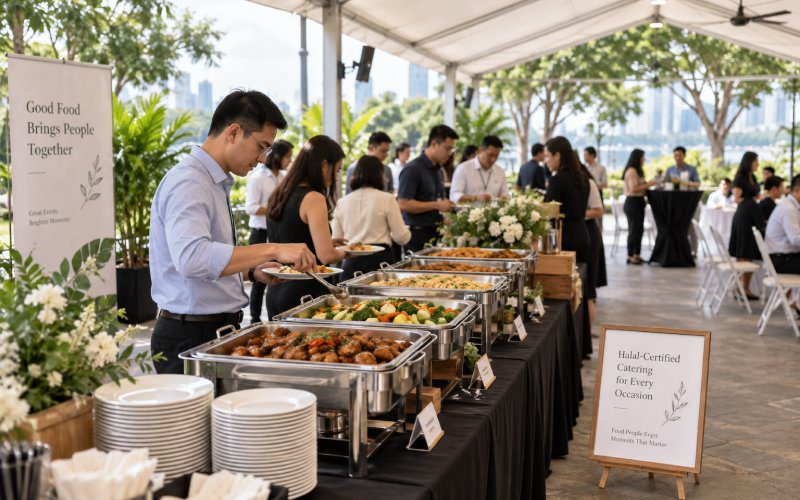
Serving food outdoors involves decisions about setup, shelter, timing, and service style that may be less significant in an indoor venue. Singapore’s heat and humidity can affect food texture and presentation, while changing weather conditions can make an elaborate setup more difficult to manage. The venue also matters because our catering team needs easy access to deliver food, move equipment, and set up the serving area.
If you are deciding how to choose catering for an outdoor event, start by looking beyond individual dishes. The best choice depends on available shelter, event duration, guest numbers, serving time, and how people will move through the space.
Here at Elsie’s Kitchen, we offer halal-certified catering across formats including bentos, mini party sets, full buffets, tea receptions, and live stations, giving you different options depending on how your outdoor event will run.
Warm, humid conditions can affect how easily food is served and how well certain dishes retain their intended texture and appearance. A service style that works smoothly indoors may require more planning outdoors.
For outdoor events, we require the catering area to be under shelter in case of wet weather. This makes a sheltered setup important from the start, especially when deciding where to place food and how much protected space is available.
Individually packed meals and compact party sets require less serving space than a conventional buffet line. They can be useful when the programme is short, or the venue has limited room for a larger arrangement.
Our bento catering provides individually packed meals that can suit corporate events, training sessions, and group gatherings. A full buffet can also work outdoors when suitable shelter, setup space, and access are in place.
Humidity can soften foods that depend on crispness, while prolonged warming can affect the appearance or texture of certain dishes. For example, prolonged heating may cause some vegetables to change colour.
To choose catering for an outdoor event well, consider how each dish will handle the serving environment. Heat and humidity can affect texture and presentation, particularly when food is displayed or held outdoors for longer.
Group size, serving time, available space, and expected guest movement can all influence which catering option is most practical.
Bentos can work well for outdoor seminars, community programmes, and staff activities where guests need to collect food within a short break. They may also be practical when attendees are spread across a larger area, and a central buffet line could create congestion.
Our mini buffet catering uses self-heating packaging, so food can be served warm without a conventional buffet setup or extra heating equipment.
This suits smaller family occasions, team gatherings, and casual celebrations that do not need a full buffet line. For an outdoor event, how you choose catering should reflect guest numbers and whether a serving line is needed.
A full buffet requires dedicated space for serving tables, food warmers, queues, and movement around the dining area. This suits events where the meal is a planned part of the programme, and the venue has enough room for a defined catering area.
Our buffet catering includes delivery, buffet table setup, food warmers, disposable wares, and collection arrangements. For larger events, staggered meal releases may also help prevent everyone from approaching the buffet at once.
Not every dish responds to outdoor conditions in the same way. Consider how the food will be packed, transported, presented, warmed, and eaten during the planned meal period.
Rice dishes, noodles, saucy proteins, and suitable vegetable dishes can fit comfortably into catered meal arrangements. Foods that rely heavily on crisp coatings or delicate textures may change more noticeably when exposed to humidity or held longer.
Rather than excluding entire food categories, you can work with our catering team to identify menu combinations suited to the planned outdoor environment and service duration.
Outdoor menu variety is not simply about offering more dishes. Familiar rice and noodle staples can provide an accessible base for a mixed guest group, while proteins, vegetables, and lighter accompaniments can create a more balanced spread in warm conditions.
Our range of Asian dishes allows you to build around familiar flavours while considering how substantial the meal should be and how guests will eat. Please share vegetarian, allergy-related, and other dietary requirements with us before the menu is confirmed. Early notice helps us plan, label, and distribute specially arranged portions to the right guests.
Delivery access, unloading distance, available shelter, and the dining area’s location can determine whether a catering arrangement is practical for the venue. These details affect how to choose catering for an outdoor event because they directly shape delivery and setup.
Outdoor venues may have vehicle restrictions, stairs, long distances from the unloading point, or limited space for equipment.
Checking venue access early gives you and our catering team a clearer picture of how we can manage delivery and setup. Sharing these details in advance can also identify whether additional arrangements are needed.
Rain planning should account for more than the buffet table. Confirm where the covered serving area will be, whether guests have a sheltered route to reach it, and whether an alternative location is available if the original area becomes unsuitable.
Your wet-weather plan should also account for whether delivery, setup, and equipment collection can take place at the backup location. Sharing this arrangement with us beforehand helps avoid last-minute changes after setup has begun.
A single buffet line may not suit an event where attendees are spread across several zones. Individually packed meals, a compact shared setup, or carefully planned buffet access may make distribution easier.
Good guest flow considers where people will be when the meal begins, how they will reach the food, and where queues could form. This can reduce unnecessary congestion around the serving area.
To decide how to choose catering for an outdoor event, coordinate delivery around the planned meal and programme. Speeches, performances, or activities can delay service, so plan around when guests will begin eating rather than event start.
For shorter breaks, bentos, packet meals, canapés, or tea reception selections can make distribution more straightforward than a large buffet. Standing receptions may suit easy-to-handle items, while seated events can accommodate individually packed or fuller meals.
Meal timing also matters for food safety. Planning delivery close to the intended mealtime can reduce how long food spends waiting before guests begin eating. For catered meals that are not kept at safe hot or cold holding temperatures, timing and the stated consume-by time are important considerations when planning the event schedule.
We advise consuming catered food within two hours of arrival. Delivery should therefore be planned around the meal itself, not just around the event start time.
Outdoor catering works best when the menu and service style reflect the actual conditions. Shelter, heat, humidity, meal timing, venue logistics, and guest movement can all influence whether bentos, mini buffets, full buffets, or another arrangement is appropriate.
We provide halal-certified catering for corporate functions, weddings, community gatherings, and social occasions. Share your guest count, serving time, shelter arrangements, venue layout, and dietary requirements as you plan your event.
Contact us to find a catering option that suits your outdoor setting, programme, and guests.