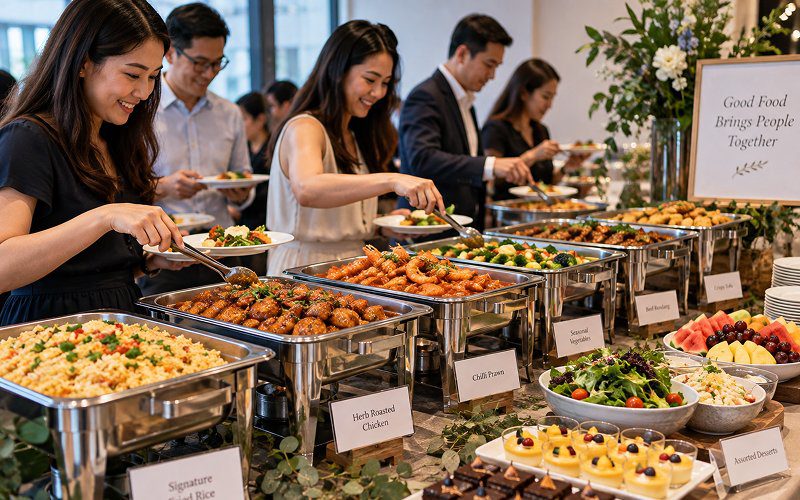
A buffet with more courses may appear more generous, but a longer menu does not automatically give guests better choices. Understanding why variety matters in a buffet menu starts with looking at what those additional dishes actually contribute. Seven distinct courses can sometimes provide more useful choice than twelve dishes with similar flavours, proteins, or preparation styles.
The right course count depends on the event’s size and purpose, how long guests have to dine, and whether the meal is a brief programme break or a central part of the occasion. It should also account for the different tastes and dietary needs around the table.
Here at Elsie’s Kitchen, we offer buffet catering packages with different course counts and minimum guest requirements. Rather than selecting the largest package by default, organisers can consider how much variety the event genuinely needs and whether each additional course improves the dining experience.
A seven-course buffet can work when you want the meal to cover the main roles without providing separate categories for several proteins, sides, and desserts. Our current Nostalgic Taste menu, for example, combines rice and noodles with meat, vegetables, savoury finger food, pastries and dessert, and a beverage.
That makes it a focused choice for events that meet its 50-person minimum and do not need separate chicken, fish, seafood, or additional side categories. The relevant question is not whether seven courses sound generous enough, but whether those categories give your particular group enough useful choice.
A smaller course count can also make the buffet easier to navigate when the serving area is compact or the meal break is limited. Guests can identify their options quickly without deciding between several dishes that fulfil similar roles.
More courses become useful when they add choices your guests will actually notice. Our current nine-course Traditional Choices menu separates chicken and fish, while the ten-course Heirloom Recipes menu includes chicken, fish, and prawn categories. Authentic Classics expands the structure further with separate seafood and egg or beancurd categories, together with a traditional Asian side dish.
This gives organisers a practical reason to move beyond seven courses: not simply because the event is larger, but because the extra categories provide different proteins, sides, or meal components. In fact, our current minimum guest requirements generally decrease across these tiers, so course count should not be used as a proxy for event size.
For a longer buffet, what matters about the menu is whether its variety solves a real need for more choice. If the additional categories suit your guest mix and dining format, a nine-, ten-, eleven-, or twelve-course option can be useful. If they mostly duplicate what your guests would already have chosen, the extra courses may add less value.
During seminars, training sessions, and company meetings, guests may have only a limited time to queue, eat, and return to the programme. A long buffet menu can slow decisions without adding much practical value.
A more focused spread can still feel complete when the selected dishes provide enough contrast and substance. The aim is to help guests eat comfortably within the available time rather than present the largest possible selection.
When the dining window is particularly short, changing the serving format may sometimes be more practical than simply reducing the number of buffet courses. For instance, organisers may consider whether bento catering services in Singapore provide a more practical format for seminars, meetings, or training sessions where a buffet queue may not suit the programme.
At weddings, anniversaries, gala dinners, and family milestones, dining may be one of the main experiences of the event. Guests may spend longer over the meal and have more opportunity to return to the buffet.
A broader spread can therefore be appropriate when each extra course introduces something different. One dish might provide a richer flavour, another a lighter accompaniment, and another a contrasting texture or protein. This gives guests more ways to build a plate that suits their tastes.
That is why, in a buffet menu, variety matters most when additional courses broaden the experience rather than simply increase the number of trays. Longer celebrations can support more choice, but the menu should still reflect the occasion, attendance, guest preferences, and time available for dining.
Buffet packages carry different minimum order quantities, so confirm attendance before comparing course counts. In our current range, higher course counts do not consistently mean higher minimum guest requirements.
Choosing more courses therefore does not necessarily mean ordering for a larger event. Compare confirmed attendance with the minimum requirement first, then look at whether the additional categories are useful for your group.
The practical question is not simply, “How many courses can we have?” It is whether those courses give the expected group enough distinct food choices without adding categories that are unlikely to be used.
The expected turnout should be reasonably clear before you select the buffet package. Ordering for the full invitation list may lead to an oversized order if several guests have not confirmed.
When comparing our buffet packages, look at the minimum guest requirement alongside event duration, course count, and meal type. This is particularly relevant when choosing corporate catering in Singapore, where a seminar lunch, staff celebration, or larger company function can have very different serving requirements.
Package details and minimum quantities can change, so check the applicable requirements when placing the order.
Our current seven-course Nostalgic Taste menu is a useful example of a focused structure. It combines staple components with a meat course, vegetables, savoury finger food, pastries and dessert, and a beverage. The categories are different enough to play separate roles in the meal without requiring several mains
By comparison, moving to higher-course packages introduces more distinct categories. Traditional Choices separates chicken and fish, while Heirloom Recipes includes a prawn category as well. That difference is more useful than simply adding another tray of a similar chicken or noodle dish.
When reviewing a buffet menu, this is why variety matters in practice: the course count only becomes meaningful when you can see what has actually been added. Compare the category structure first, then decide whether those extra choices suit the people attending.
Before adding another dish, consider what it contributes to the existing spread. If you already have a rich poultry main, another dish with a lighter preparation or different protein may broaden the meal more effectively than a second similar chicken dish.
Texture is important too. Combining softer dishes with crisp vegetables or other contrasting sides can make the overall meal feel less repetitive. The same principle applies to flavour, where balancing richer, savoury choices with lighter dishes can give guests more flexibility.
Singapore’s Health Promotion Board also provides a useful guide to building a balanced meal across food groups. It is not a buffet-planning guide, but it can serve as a general reference when considering whether the overall spread is too heavily weighted towards one type of food.
This approach makes additional courses purposeful rather than treating quantity as the main measure of generosity.
The guest mix also helps explain why variety in a buffet menu matters. An office function may bring together colleagues with different tastes, while a family celebration can include guests with varied appetites and dietary requirements.
Instead of trying to anticipate every preference by continually adding dishes, organisers can aim for a balanced selection. Familiar options can sit alongside more distinctive dishes, while different proteins, vegetables, textures, and flavour profiles give guests several ways to assemble a meal they enjoy.
A larger menu should not automatically be mistaken for a more inclusive one. Guests with vegetarian or other dietary needs may still have few suitable food choices when most courses do not meet their requirements.
Organisers should therefore gather dietary requirements before finalising the menu and share them with us when discussing the order. Where suitable arrangements are available, the aim should be to give affected guests a satisfying meal rather than assume one side dish covers several different dietary needs.
The right course count depends on the event size, dining time, guest preferences, and whether food is a quick programme break or a central part of the occasion. Start with the minimum guest requirement, then compare what the next package actually adds: separate protein categories, more sides, another dessert component, or other choices your group is likely to use.
Ultimately, why variety matters in a buffet menu comes down to giving guests meaningful differences between the dishes available. Matching different flavours, proteins, textures, and course types can make the spread feel generous without unnecessary repetition.
Elsie’s Kitchen provides buffet catering for corporate functions, family gatherings, and celebrations in Singapore, prepared through our Halal-certified central kitchen. Share your expected attendance, event format, dining duration, and dietary requirements with us so we can help you identify a buffet arrangement with enough meaningful choice for the occasion.